

Why I’ve Evolved the Way I Teach
One of my tendencies as a teacher has always been to give a lot.
Partly, it is because I’m a giver. I naturally want to offer, support and share.
But it also comes from something deeper. I love to dive beneath the surface. I’m not particularly interested in staying with things at a superficial level, and when I discover something that opens a deeper layer of understanding or experience, I want to give my students the opportunity to go there too.
And then there is the professional side of it. I care deeply about professionalism. When I create a training, I want people to receive a solid foundation, a broad range of tools and enough understanding to genuinely deepen their practice and be well prepared to teach.
So I’ve packed a lot into my classes, workshops, retreats and teacher trainings.
A lot of tools. A lot of practices. A lot of information.
And for a long time, I thought this was part of what made teaching valuable: the more I could offer, the more people could take away.
But over the years, I’ve learned that more is sometimes less.
Making space for something to land
There is a difference between being exposed to something and actually learning it.
We can hear an idea, understand it intellectually and even feel inspired by it. But that doesn’t necessarily mean it has become part of our experience.
Sometimes we need to stay with something.
To practise it again.
To question it.
To contemplate it.
To play with it.
To notice what changes when we meet it from a different place.
And sometimes, the most useful thing a teacher can do is not introduce the next thing.
It is to create enough space for what is already there to land.
This has gradually changed the way I teach.
Not because I have less to share, or because I value knowledge any less. I still love bringing in different perspectives, practices and tools.
But I’ve become more interested in what can arise when we allow ourselves the space and time to stay with the discomfort, and sometimes the excitement, of discovery.
That space of not knowing. Of not being sure. Of resisting the impulse to immediately find an answer or move on to the next thing.
Simply listening. Paying attention. Seeing what emerges.
From giving more to creating more space
I think my move to Mallorca has played a part in this too.
There is something about living here that has brought much more spaciousness into my own life. More room to pause. More time outdoors. More moments that aren’t planned or filled.
And with that spaciousness, I’ve become more comfortable with not always knowing what comes next.
Sometimes, when we leave a little room, something arises that we could never have planned.
A conversation.
A question.
A new perspective.
A moment of insight.
I’ve started to value that space not as an absence of something, but as part of the practice itself.
I see this in my classes.
There are moments when a practice needs challenge, complexity or something new to explore. And there are moments when going back to something simple, staying with a sensation or repeating a familiar pattern can reveal much more.
The same is true in a retreat.
We can fill a schedule with practices, workshops and conversations. Or we can leave some room for people to walk, rest, digest what they have experienced, have an unexpected conversation, or simply be.
Often, those quieter spaces are where something meaningful happens.
This doesn’t mean doing less for the sake of doing less.
It means becoming more discerning about what is needed, when it is needed, and what we do with the space in between.
Letting this evolution shape the way I teach
I’ve noticed that this shift has gradually found its way into all the different ways I teach.
In a class, it might mean staying with one exploration for longer rather than moving quickly to the next.
In a workshop, it might mean giving people more time to experiment and discover rather than trying to cover everything I had planned.
In a retreat, it might mean leaving more room for silence, conversation, rest or simply allowing the day to unfold.
And it has naturally found its way into my teacher training too.
For the 2027 Live IN Yoga 200 Hour Teacher Training, I wanted to keep the breadth and depth that are important to me, while creating more space around the learning.
The material is still there. The hours are still there. The tools are still there.
But some of the learning happens at your own pace, and the time we spend together can be used differently. We can explore, practise, teach, question and integrate rather than simply moving from one subject to the next.
For me, that is a very different way of thinking about what it means to offer a lot.
It is not only about how much we give.
It is also about creating the conditions for people to receive it.
Learning to teach is learning to see
Over the years, my understanding of teaching itself has also changed.
To me, learning to teach is not only learning how to explain an asana or construct a sequence.
It is learning to see.
Ourselves and others.
To notice what is happening in front of us. To recognise that the same instruction, adjustment or approach will not necessarily serve every person or every moment.
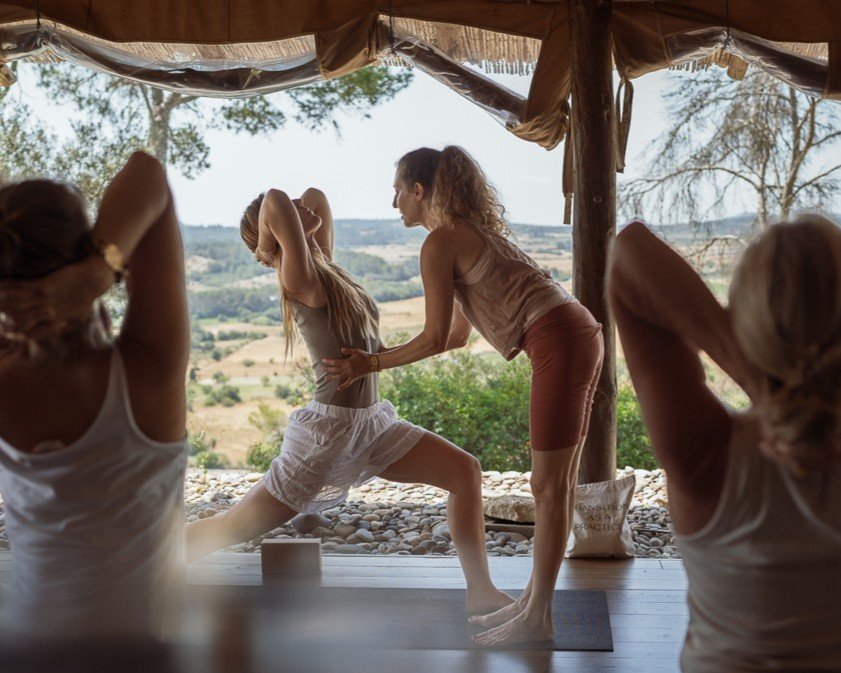
This is one of the reasons my approach to hands-on assists has changed over the years too.
Sometimes a deeper, more direct assist is useful.
Sometimes the most appropriate touch is much more subtle.
Sometimes the best assistance is not physical at all.
The skill is not in knowing one correct way to assist. It is in developing the sensitivity and discernment to recognise what might be useful here, with this person, in this moment.
And this kind of learning also needs to be experienced.
We need opportunities to try something, see what happens, receive feedback, try again and gradually develop our own understanding.
That is true whether we are learning to teach a yoga class, working with another person, or simply learning how to relate to ourselves with a little more awareness.
The practice of being together
And then there is something else that has become increasingly important to me: the practice of being together.
I don’t mean simply being in the same room.
We can be surrounded by people and still remain separate.
I mean participating. Engaging. Listening. Responding. Allowing ourselves to be affected by one another.
There is something unique about practising yoga together.
And even more so in a retreat or a teacher training, where we share a significant experience over time.
We see one another practise, struggle, discover, question, laugh and change.
I think of this a little like a prism.
When light passes through a prism, it doesn’t simply bounce back as a reflection. It is refracted, creating something new through the particular qualities of what it passes through.
The yogic tradition offers another beautiful image: Anantashesha, the cosmic serpent with a thousand jewel-ornamented hoods, each jewel representing an individual mind refracting consciousness through its own unique perspective.
What we receive from one another passes through our own experiences, perspectives, questions and ways of seeing, and comes out differently in each of us.
So what we express can be completely our own, while still carrying something of all the people and experiences that have touched us.
We are each changed by one another, without becoming the same.
And perhaps this is one of the beautiful paradoxes of learning together:
our individuality doesn’t have to disappear through connection. It can become more fully expressed through it.
What does this have to do with yoga?
For me, quite a lot.
The physical practice may be where many of us begin. But yoga has always felt much bigger than what happens in the shapes we make with our bodies.
As we practise, we can begin to notice our patterns. The ways we hold on. The ways we react. The ways we protect ourselves, reach for something, avoid something, or relate to difficulty.
And when we practise alongside others, those layers don’t disappear into isolation. They meet relationship.
We see ourselves reflected in others.
We are challenged by them. Inspired by them. Sometimes irritated by them. Sometimes surprised by what becomes possible because someone else showed us a different way.
For me, this is part of what makes teaching yoga so interesting.
We are not only learning how to move better.
We are learning how to pay attention.
And perhaps, with time, how to meet ourselves and each other a little differently.
An invitation to notice your own evolution
The 2027 Live IN Yoga 200 Hour Teacher Training is one expression of this evolution in the way I teach.
If you are curious about the training, you can find more information here.
But the question behind all of this is much bigger than a teacher training.
I wonder what has changed in the way you relate to other people as you have evolved.
Perhaps the way you communicate at work.
The way you listen to a friend.
The way you respond when someone sees something differently from you.
The way you offer support, or know when not to.
The way you make space for someone else without disappearing yourself.
Sometimes our evolution isn’t most visible in what we know or what we can do.
Perhaps it is visible in the way we meet what is in front of us.
In the space we leave.
In what we no longer need to fill.
And in the way we allow ourselves, and others, to become more fully who we are.
I’d love to hear from you.
What has your own evolution changed in the way you relate to other people? What have you learned to make space for?
You can write to me at love@alitbarsadeh.com. I’d genuinely love to hear your thoughts.
If this speaks to you, I share reflections like this via email. You’re welcome to sign up and receive them here.